

boisei labs’ ethical framework and Toward net good white paper
06 November 2026
boisei labs is a ‘tech for good’ venture studio. But what is good? This complex question is compounded by our technology innovation-focused approach, through which tradeoffs are effectively unavoidable. To help navigate this challenge, we developed an ethical framework and process, described in our Toward net good white paper. We follow this process while deciding what ventures to build (or not) and how to do so.
Read the full story and find links to the white paper and inquiry tool below.
Why are we doing this?
Our venture studio aims to build companies targeting systemic environmental and social challenges through market-driven economics. We perceive immense opportunity to do so. But even the seemingly straightforward question “what is good?” actually isn’t straightforward, and we take our opportunity and responsibility as impact builders (and investors) very seriously.
Therefore, we desired a framework and process to help us holistically consider the potential benefits vs. negative tradeoffs of what we build. Ethics can help us wrestle with complex environmental and societal inputs and outputs for our startups in ways quantitative metrics alone cannot.
A salient quote from our Toward net good white paper (click on the title page image below to access the full PDF) presenting this approach:
“Our grand ambition is to develop ventures that create net good, which we define as meaningful improvements for people and the planet, pursued with sustained attention to harms, obligations, alternatives, power dynamics and uncertainties. This paper introduces our ethical orientation and our intentionally qualitative, reflective process for examining assumptions, competing priorities, justifications, and trade-offs in our venture building work.”
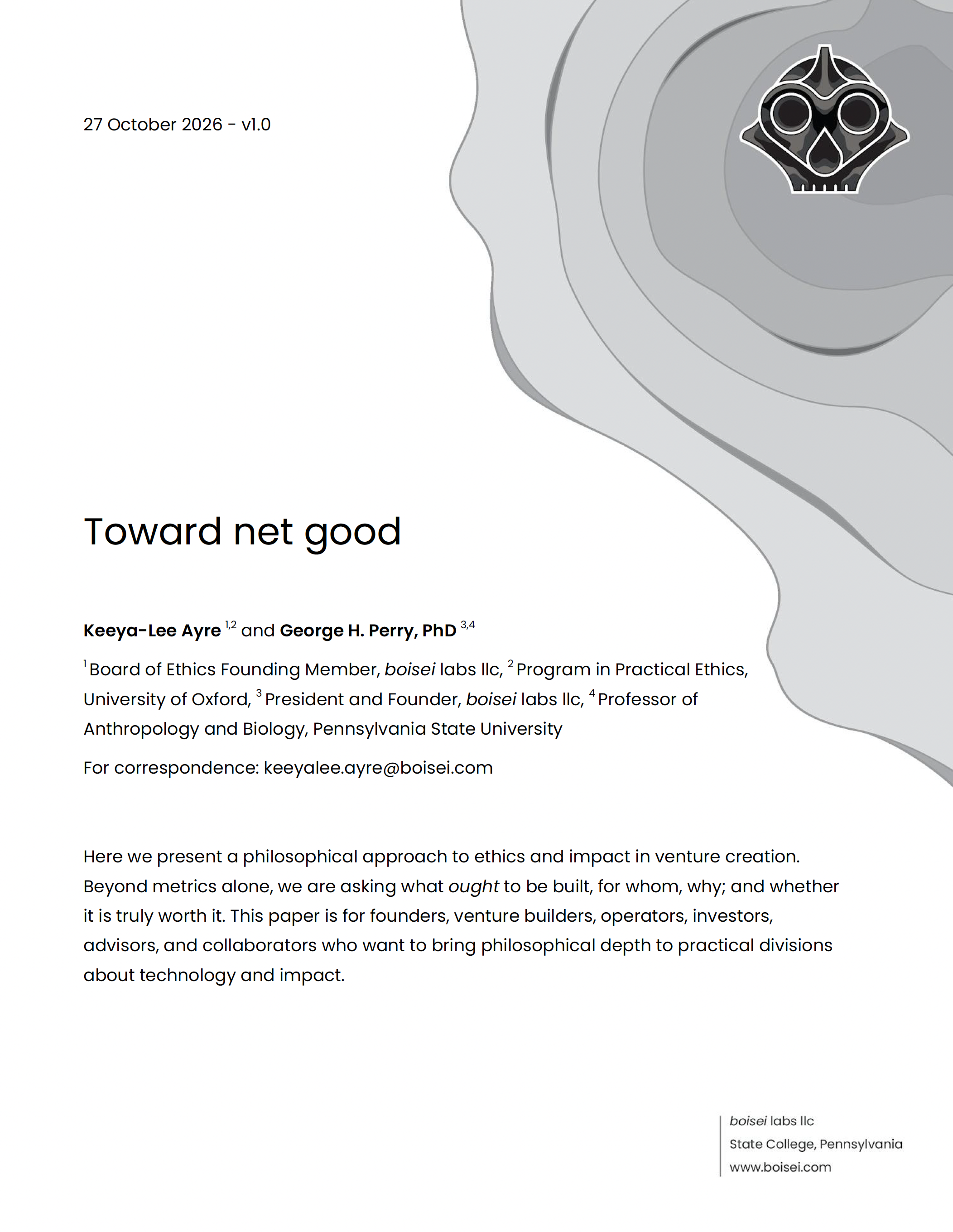
“Toward net good” white paper. Click the image to access the full PDF.
Our intention is to complement rather than obviate quantitative impact frameworks such as carbon emissions life cycle assessments. We intentionally ask different questions that help us also consider not directly comparable or necessarily even quantifiable benefits and harms. While this approach may feel unsatisfyingly messy at times, messiness is simply the reality more often than not. We’re embracing the mess to help improve our ventures and their impacts on others.
The purpose of our approach is to make ethical reasoning more explicit, contestable, revisable, and accountable. We will publish the writeups that emerge from this process to provide opportunities for external dialog. For us, such dialog would benefit our iterative venture development process and our ethical framework’s continuing evolution. For other venture builders, founders, operators, investors, and academics, we hope that these outputs will be useful data on the inherent mix of opportunities and challenges associated with building in the tech for good space.
What is involved?
Our process is supported by a Venture Ethics and Impact Inquiry Tool (click on the image below to access the worksheet). The tool is effectively a qualitative critical-thinking workbook to encourage open and rigorous thinking that surfaces assumptions, tensions, risks, and tradeoffs. A team member or a small working group will proceed through the prompts to help guide their research while documenting missing perspectives and areas of disagreement. Not all prompts will be applicable for every venture or at every stage of a given venture’s lifecycle. Importantly, information entered into the tool itself is not the ultimate output from this process.
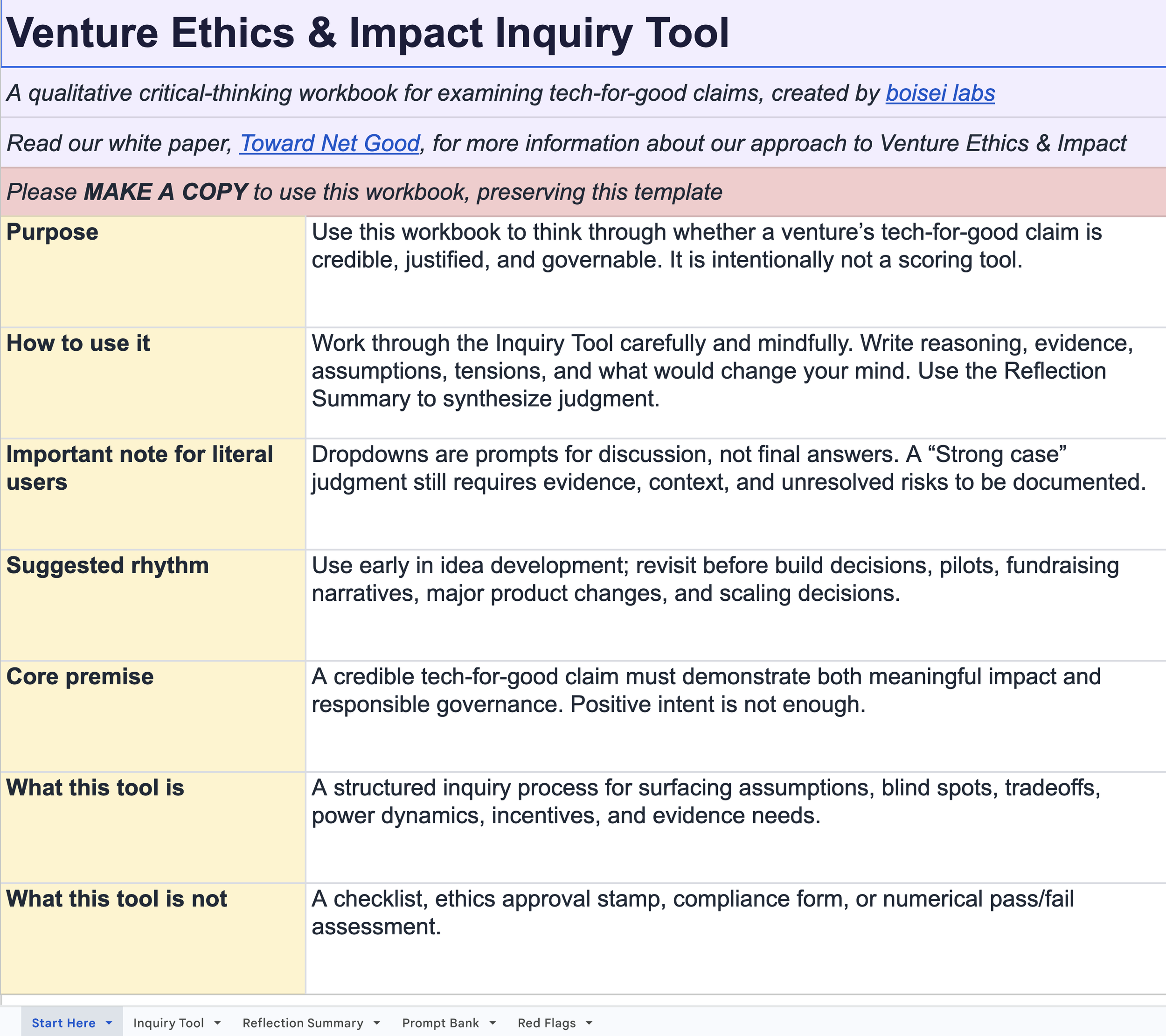
Inquiry Tool. Click the image to access the Sheets file; copy to your Drive. Note the multiple tabs.
For us, the finished product from each entry into this process will be a standalone writeup that does two major things. First, it should describe the landscape of anticipated benefits and tradeoffs arising from the venture, along with uncertainties and alternative forward paths consideration. Second, the writeup should record the outcomes of our company-wide review of the first part. What adjustments were made, if any, and why? Will we begin collecting additional data to help us close key information gaps? And so on.
Very importantly, this process will be iterative, with assessments conducted at each major stage of the venture building process and then at defined intervals thereafter. Writeups at the idea exploration and design stages may be relatively brief. Later-stage writeups could become lengthy and feature expansive data collection and analysis, depending on the scale and complexity of the venture and what would be beneficial.
We genuinely believe that, typically, this process will ultimately help us improve our ventures more rapidly and markedly than without it. We have anecdotal experience with this phenomenon, i.e. whereby the process of challenging ourselves to address an unquantifiable technology risk led us to a creative redesign that put the company on a much stronger impact and value trajectory. Our new process will now help us do this more systematically.
Of course, there will be times when this process will lead us to halt an otherwise promising venture idea, e.g. if we identify unbalanced risks that we cannot adequately mitigate or obviate. We accept this outcome; not all ideas need to be pursued. Both boisei labs and the ultimate impacts of our collective ventures benefit by surfacing issues sooner rather than later, whether because we then resolve those issues more efficiently or because we divert time and resources to different ventures.
What are we going to do next?
We’ve initialized the above process for each of our in-process venture builds. The resulting writeups will be made publicly available as those ventures are announced. We also have several venture concepts that will receive this treatment starting now, and then continuing in iterative fashion if those concepts are advanced to our design stage. And so on, broadly, as we move forward as a venture studio.
Additionally, boisei labs employs a professional Board of Ethics, currently comprised of three members. Following appropriate approvals and consent, our Board of Ethics will observe our internal implementation of this process and contribute to our related decision-making discussions using Participatory Action Research methods. This work will ultimately lead to peer reviewed academic publications on the practical application of ethical frameworks in venture building context.
We welcome dialog and collaboration. If any other teams adopt our approach (or a modified version or portion of it), we would love to know. If you might consider consenting to interviews with members of our Board of Ethics as part of our ongoing research, this could be a valuable contribution to broader knowledge and application. Finally, discussions with builders, investors, and others incorporating ethics into their venture building work in other ways would also be (likely mutually!) interesting, so please consider reaching out.
For collaboration and dialog inquiries, contact Keeya-Lee Ayre, Board of Ethics Founding Member, boisei labs: keeyalee.ayre (at) boisei (dot) com
About boisei labs
boisei labs is a US-based, ‘tech for good’ venture studio and family office building and investing in solutions targeting systemic environmental and social challenges through market-driven economics.